
JEE Main & Advanced Online Coaching 2027: Updated Syllabus, Exam Pattern, Important Dates

Prepare for IIT JEE 2027 with latest syllabus, exam dates, eligibility, and counselling updates. Know all about JEE Main, Advanced, and top engineering colleges.

Courses

Access Our Latest Courses

Blog

Read Our Latest Blogs

Test Series

Explore JEE 2026 Test Series

Books

Find Preparation Books

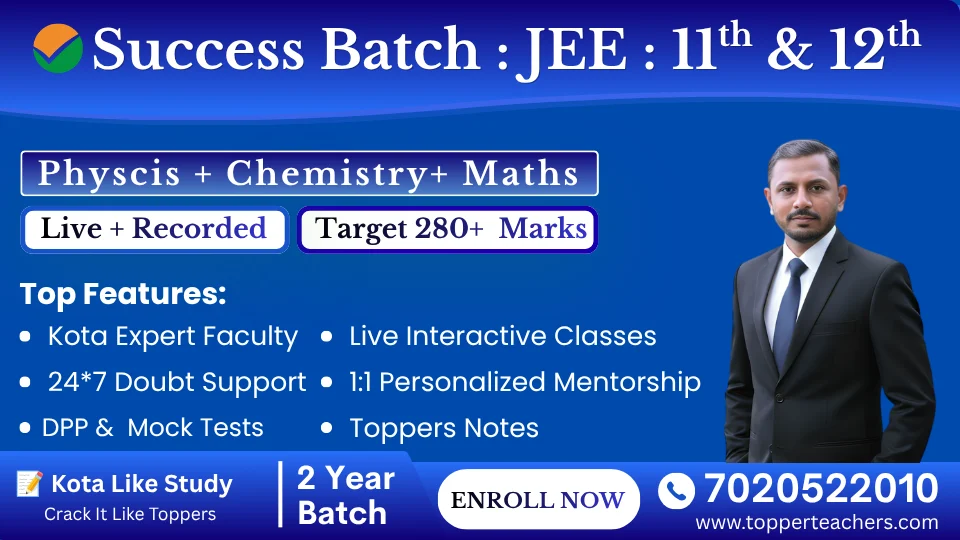
Class 11th & 12th - IIT JEE Courses

JEE - 11th & 12th

Class 11th & 12th

Success Batch

For IIT-JEE 2027 Aspirants

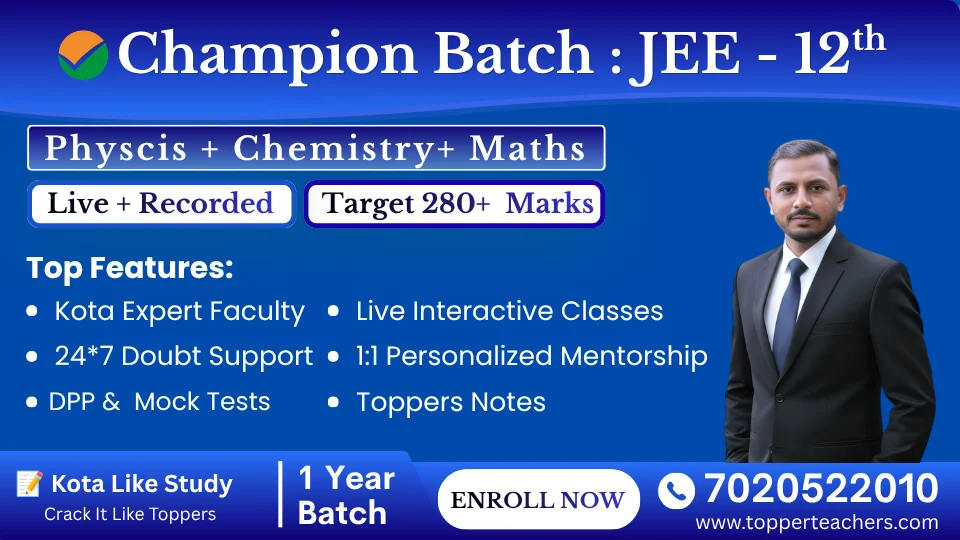
JEE - 12th

Class 12th

Champion Batch

For IIT-JEE 2027 Aspirants

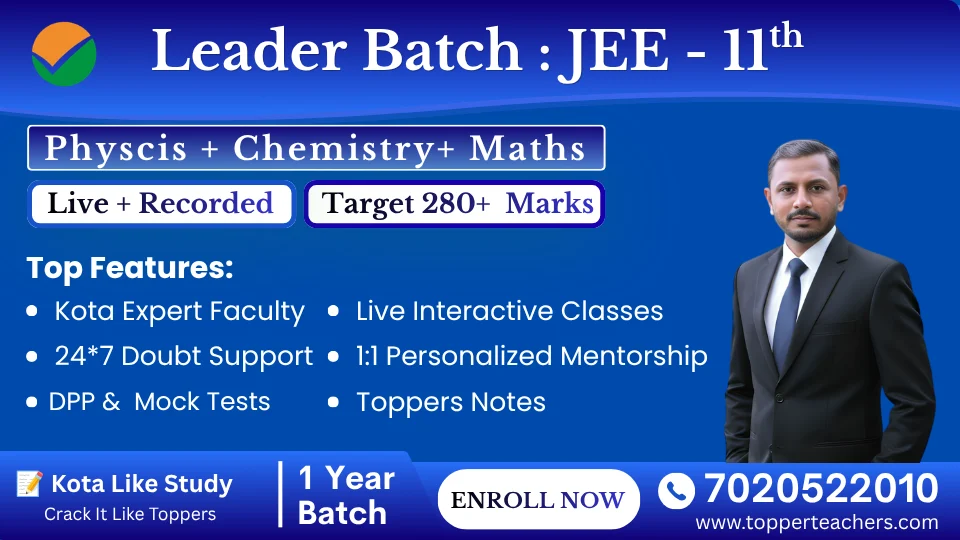
JEE - 11th

Class 11th

Leader Batch

For IIT-JEE 2027 Aspirants

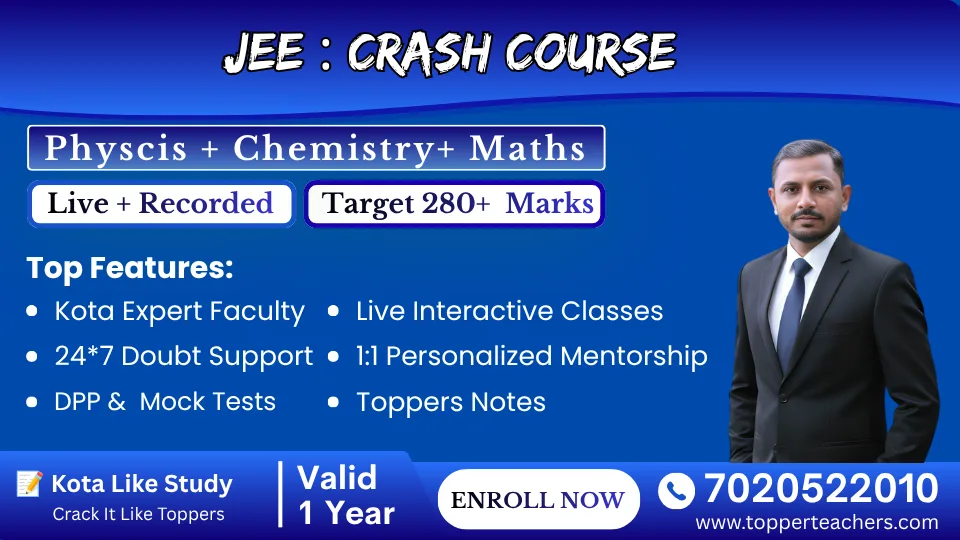
Crash & Droppers IIT JEE Courses

JEE - Crash Course

JEE Crash Course

For IIT-JEE 2027 Aspirants

JEE - Droppers Course

JEE Droppers

For IIT-JEE 2027 Aspirants

JEE 2027 Latest Updates: Syllabus, Exam Dates, Eligibility & More

Are you planning to appear for JEE 2027? Whether you’re aiming for IITs, NITs, IIITs, or top engineering colleges, staying updated with the latest information is the first step toward your goal. Here’s a complete and easy-to-understand guide covering everything you need to know about JEE Main and Advanced 2027.


JEE Exam Schedule

JEE 2027 will be conducted in two phases:

  • Session 1: January 2027

  • Session 2: April 2027

The exam will be conducted by NTA (National Testing Agency), and the official notification is expected to be released in November.

Students can appear in one or both sessions — and the best score will be considered for admission.


JEE Syllabus & Exam Pattern

There are no major changes expected in the exam pattern. The syllabus will be based on Class 11 and 12 NCERT topics from:

  • Physics

  • Chemistry

  • Mathematics

JEE Main 2027 Paper Pattern:

PaperCourseQuestion TypeTotal Marks
Paper 1B.E./B.Tech75 MCQs300 Marks
Paper 2AB.Arch77 Questions (includes offline Drawing Test)400 Marks
Paper 2BB.Plan100 MCQs400 Marks

Who Will Conduct JEE Advanced 2027?

While NTA conducts JEE Main, the JEE Advanced 2027 will likely be organized by IIT Roorkee, as each year a different IIT takes charge of conducting the exam.


What Is JEE 2027?

JEE (Joint Entrance Examination) is the gateway to India’s top engineering institutes, including:

  • Indian Institutes of Technology (IITs)

  • National Institutes of Technology (NITs)

  • Indian Institutes of Information Technology (IIITs)

  • Centrally Funded Technical Institutions (CFTIs)


JEE Eligibility Criteria

Before applying, make sure you meet the following eligibility requirements:

CriteriaDetails
QualificationPassed or appearing in Class 12 (or equivalent)
Age LimitNo age limit
Attempts AllowedTwo in 2026 (Jan & April)
Marks (General)75% in Class 12 or top 20 percentile
Marks (Reserved)65% in Class 12
Required Subjects 
– B.Tech: Physics, Math + 1 optional subject 
– B.Arch: Physics, Chemistry, Math 
– B.Plan: Mathematics only 

Final Thoughts

JEE 2027 is a big milestone for every engineering aspirant. With competition increasing every year, early preparation and staying informed will give you a strong advantage. Keep visiting the official NTA website for the latest notifications and updates:
👉 jeemain.nta.ac.in


Stay tuned for more exam tips, preparation strategies, and mock test resources to ace JEE 2027!

JEE Main Syllabus & Exam Pattern

Overview

JEE Main is based on three core subjects — Physics, Chemistry, and Mathematics — aligned with the NCERT Class 11 & 12 curriculum, as per NTA guidelines. Here’s a subject-wise breakdown:


Subject-wise Syllabus

Mathematics

  • Sets, Relations & Functions

  • Complex Numbers & Quadratic Equations

  • Matrices & Determinants

  • Permutation & Combination

  • Binomial Theorem

  • Sequences & Series

  • Limit, Continuity & Differentiability

  • Integral & Differential Calculus

  • Coordinate & 3D Geometry

  • Vector Algebra

  • Statistics & Probability

  • Trigonometry

Physics

  • Physics & Measurement

  • Kinematics, Laws of Motion

  • Work, Energy & Power

  • Rotational Motion, Gravitation

  • Properties of Solids & Liquids

  • Thermodynamics

  • Kinetic Theory of Gases

  • Oscillations & Waves

  • Electrostatics, Current Electricity

  • Magnetism & Electromagnetic Induction

  • Optics, Dual Nature of Matter

  • Atoms & Nuclei, Electronic Devices

  • Electromagnetic Waves, Experiment Skills

Chemistry

Physical Chemistry:

  • Basic Concepts of Chemistry

  • Atomic Structure, Thermodynamics

  • Solutions, Equilibrium

  • Redox Reactions, Electrochemistry

  • Chemical Kinetics

Inorganic Chemistry:

  • Classification of Elements

  • Chemical Bonding

  • p, d, f-block Elements

  • Coordination Compounds

Organic Chemistry:

  • Purification, Basic Principles

  • Hydrocarbons

  • Organic Compounds (Halogen, Oxygen, Nitrogen)

  • Biomolecules, Practical Chemistry


JEE Main Exam Pattern

ParticularsPaper 1 (B.E./B.Tech)Paper 2A (B.Arch)Paper 2B (B.Plan)
Mode of ExamOnline (Computer-based)Aptitude/Math (Online) + Drawing (Offline)Online
Duration3 Hours3 Hours3 Hours
SectionsPhysics, Chemistry, MathMath, Aptitude, DrawingMath, Aptitude, Planning
Total Questions7577100
Total Marks300400400
Type of QuestionsMCQs + NumericalMCQs, Numerical, DrawingMCQs + Numerical
Marking Scheme+4 for correct, -1 for wrongSame (Drawing = 50 marks)+4/-1 for correct/incorrect
Language Options13 (English, Hindi + Regional)1313

JEE Advanced Eligibility

CriteriaDetails
JEE Main RankTop 2,50,000 rank holders in Paper 1
Age LimitBorn on or after Oct 1, 2000 (Relaxation: 5 years for SC/ST/PwD)
AttemptsMax. 2 attempts in 2 consecutive years
12th QualificationPassed 12th in 2023, 2024, or appearing in 2025
Category ReservationGEN-EWS: 10%, OBC-NCL: 27%, SC: 15%, ST: 7.5%, OPEN: 40.5%, PwD: 5%

JEE Advanced Syllabus Breakdown

Mathematics

  • Algebra, Matrices, Probability

  • Trigonometry, Calculus

  • Analytical & Coordinate Geometry

  • Vectors

Physics

  • General Concepts, Mechanics

  • Thermal Physics, Electricity & Magnetism

  • Optics, Modern Physics

Chemistry

Physical Chemistry:

  • Atomic Structure, Energetics

  • Chemical Equilibrium, Kinetics

  • Electrochemistry, Surface Chemistry

Inorganic Chemistry:

  • Periodicity, Chemical Bonding

  • Solid State, Solutions, Nuclear Chemistry

Organic Chemistry:

  • Basic Principles, Hydrocarbons

  • Functional Groups (O, N, Halogens)

  • Biomolecules


JEE Advanced Exam Pattern

Each of the two compulsory papers includes 4 sections with different marking schemes. Total duration: 3 hours per paper.

Paper 1 (Sample Structure)

SectionQuestionsMarksMarking Scheme
Sec 1412+3 Correct, -1 Incorrect, 0 Unattempted
Sec 2312Partial marking with stepwise credit
Sec 3624+4 Correct, 0 Incorrect
Sec 4412+3 Correct, -1 Incorrect

Paper 2 (Similar Structure)

SectionQuestionsMarksMarking Scheme
Sec 1412+3 Correct, -1 Incorrect, 0 Unanswered
Sec 2312Partial marking for multiple correct
Sec 3624+4 Correct, No Negative
Sec 4412+3 Correct, No Negative

Top Engineering Colleges in India After JEE 2025

After appearing for JEE 2026, students have the opportunity to secure admission into India’s most prestigious engineering institutions. Based on your JEE Main or JEE Advanced performance, you can apply to IITs, NITs, IIITs, and other top institutes through JoSAA Counselling.


Top IITs in India Through JEE Advanced 2025

Candidates who qualify JEE Advanced 2025 are eligible for admission into the Indian Institutes of Technology (IITs), renowned globally for their academic excellence and cutting-edge research.

List of Premier IITs:

  • IIT Bombay

  • IIT Delhi

  • IIT Madras

  • IIT Kanpur

  • IIT Kharagpur

  • IIT Roorkee

  • IIT Guwahati

  • IIT Hyderabad

  • IIT BHU (Varanasi)

  • IIT Indore

  • IIT Dhanbad (ISM)

  • IIT Patna

  • IIT Bhubaneswar

  • IIT Gandhinagar

  • IIT Ropar

  • IIT Mandi

  • IIT Jodhpur

  • IIT Palakkad

  • IIT Tirupati

  • IIT Bhilai

  • IIT Jammu

  • IIT Dharwad


Top NITs in India Through JEE Main 2025

Students who qualify JEE Main 2025 can apply to the National Institutes of Technology (NITs), known for offering strong technical education and excellent placement records.

Notable NITs Include:

  • NIT Tiruchirappalli (Trichy)

  • NIT Surathkal

  • NIT Warangal

  • NIT Rourkela

  • NIT Allahabad (MNNIT)

  • NIT Calicut

  • NIT Kurukshetra

  • NIT Jaipur (MNIT)

  • NIT Durgapur

  • NIT Bhopal (MANIT)

  • NIT Nagpur (VNIT)

  • NIT Patna

  • NIT Jalandhar

  • NIT Raipur

  • NIT Hamirpur

  • NIT Silchar

  • NIT Srinagar

  • NIT Arunachal Pradesh

  • NIT Agartala

  • NIT Goa

  • NIT Sikkim

  • NIT Manipur

  • NIT Meghalaya

  • NIT Mizoram

  • NIT Nagaland

  • NIT Puducherry

  • NIT Delhi

  • NIT Uttarakhand

  • NIT Surat


Top IIITs in India Through JEE Main 2025

The Indian Institutes of Information Technology (IIITs) specialize in computer science and information technology disciplines, offering excellent opportunities for tech-focused students.

Prominent IIITs Include:

  • IIIT Hyderabad

  • IIIT Bangalore

  • IIIT Allahabad

  • IIITDM Jabalpur

  • IIITDM Kancheepuram

  • IIITDM Kurnool

  • IIIT Gwalior (ABV IIITM)

  • IIIT Guwahati

  • IIIT Pune

  • IIIT Lucknow

  • IIIT Nagpur

  • IIIT Bhubaneswar

  • IIIT Kota

  • IIIT Ranchi

  • IIIT Dharwad

  • IIIT Sonepat

  • IIIT Una

  • IIIT Vadodara

  • IIIT Kalyani

  • IIIT Bhopal

  • IIIT Tiruchirapalli

  • IIIT Agartala

  • IIIT Surat

  • IIIT Kottayam

  • IIIT Manipur

  • IIIT Bhagalpur

  • IIIT Sri City

  • IIIT Karnataka


Admission Process

Admission to these colleges is conducted through JoSAA (Joint Seat Allocation Authority) based on:

  • Your JEE Main or JEE Advanced rank

  • College preferences filled during counselling

FAQs About JEE

1. What is JEE?
JEE (Joint Entrance Examination) is a national-level engineering entrance exam conducted for admission into top engineering institutes like IITs, NITs, IIITs, and other prestigious colleges in India.

2. How many phases are there in JEE?
JEE has two phases:

  • JEE Main – for admission into NITs, IIITs, and other centrally funded institutes.

  • JEE Advanced – for admission into the Indian Institutes of Technology (IITs).

3. Who conducts JEE Main and JEE Advanced?

  • JEE Main is conducted by the National Testing Agency (NTA).

  • JEE Advanced is conducted by one of the IITs on a rotational basis under the supervision of the Joint Admission Board (JAB).

4. What is the eligibility for JEE Main?

  • Students must have passed or appeared in the Class 12 exam with Physics, Chemistry, and Mathematics.

  • There is no age limit for JEE Main.

5. What is the eligibility for JEE Advanced?

  • Candidates must qualify JEE Main and be among the top 2,50,000 rankers.

  • They should meet age and attempt criteria as specified by the conducting IIT.

6. How many attempts are allowed for JEE?

  • JEE Main: 3 attempts (in 3 consecutive years).

  • JEE Advanced: 2 attempts in 2 consecutive years.

7. What is the exam mode for JEE Main?
JEE Main is a computer-based test (online mode) except for the drawing section in B.Arch paper.

8. What are the subjects covered in JEE?
Physics, Chemistry, and Mathematics are the core subjects for both JEE Main and JEE Advanced.

9. Is there negative marking in JEE?
Yes, both JEE Main and JEE Advanced have negative marking for incorrect answers in objective-type questions.

10. Can I prepare for JEE online?
Yes, platforms like TopperTeachers Academy offer expert guidance, video lectures, practice tests, and doubt-solving sessions to help students crack JEE effectively.

Shopping Cart