
Union Budget 2026-27: A Comprehensive Analysis for UPSC & MPSC Aspirants
Introduction
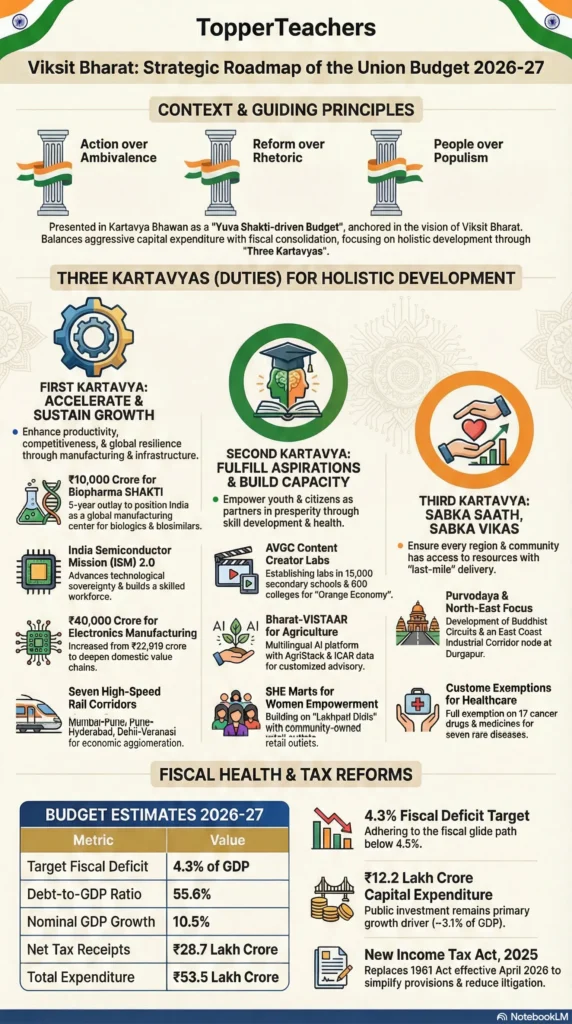
The Union Budget 2026-27, presented by the Union Minister of Finance and Corporate Affairs, marks a significant milestone as the first budget prepared in the newly inaugurated Kartavya Bhawan. Themed as a “Yuva Shakti-driven Budget,” it embodies the vision of Viksit Bharat (Developed India) and is anchored in the guiding principles of Action over Ambivalence, Reform over Rhetoric, and People over Populism.
For civil services aspirants, this budget represents a crucial policy document that reflects India’s developmental priorities, fiscal strategy, and approach to emerging global challenges. Understanding its nuances is essential for both Prelims and Mains preparation.
The Framework: Three Kartavyas (Duties)
The budget is structured around three fundamental duties aimed at holistic national development:
First Kartavya: Accelerate and Sustain Economic Growth
Focuses on enhancing productivity, competitiveness, and building resilience against volatile global dynamics.
Second Kartavya: Fulfill Aspirations and Build Capacity
Aims to empower youth and citizens, making them strong partners in India’s prosperity journey.
Third Kartavya: Sabka Saath, Sabka Vikas
Ensures every family, community, region, and sector has access to resources and opportunities, with special emphasis on last-mile delivery.
First Kartavya: Manufacturing and Industrial Push
1. Strategic and Frontier Sectors
The budget identifies seven strategic sectors to position India as a global manufacturing hub:
Biopharma SHAKTI
- Full Form: Strategy for Healthcare Advancement through Knowledge, Technology and Innovation
- Outlay: ₹10,000 crore over five years
- Objective: Position India as a global biopharma manufacturing center
- Key Components:
- Focus on biologics and biosimilars
- Establishment of 3 new National Institutes of Pharmaceutical Education and Research (NIPERs)
- Upgradation of 7 existing institutes
- Strengthening of Central Drugs Standard Control Organisation (CDSCO) to global standards
UPSC Relevance: Links to GS Paper III (Science and Technology, Economy), GS Paper II (Health, Governance)
India Semiconductor Mission 2.0
Building on ISM 1.0, this initiative advances India’s technological sovereignty by:
- Manufacturing semiconductor equipment and materials
- Strengthening resilient supply chains
- Establishing industry-led R&D and training centers
- Creating a skilled workforce for economic and national security
Critical for Exam: Understanding the strategic importance of semiconductor self-reliance in the context of global supply chain disruptions and China’s dominance.
Electronics Components Manufacturing Scheme
- Outlay increased from ₹22,919 crore to ₹40,000 crore
- Aims to deepen domestic value chains
- Boost electronics manufacturing ecosystem
Rare Earth Corridors
- Locations: Odisha, Kerala, Andhra Pradesh, and Tamil Nadu
- Purpose: Mining, processing, and manufacturing of Rare Earth Permanent Magnets (REPM)
- Significance: Reduce import dependence on critical minerals essential for green technologies and defense applications
MPSC Relevance: Candidates should note the inclusion of specific states and understand regional development implications.
Chemical Parks
Three Chemical Parks proposed under a cluster-based, plug-and-play model to reduce import dependence and promote industrial efficiency.
Capital Goods and Container Manufacturing
- Hi-Tech Tool Rooms by Central Public Sector Enterprises (CPSEs)
- Construction and Infrastructure Equipment (CIE) Scheme
- ₹10,000 crore Container Manufacturing Scheme
- Impact: Strengthen domestic capital goods and logistics manufacturing, reduce trade deficit
2. Textile Sector Rejuvenation
Integrated Textile Programme comprising:
- National Fibre Scheme: Promoting natural and synthetic fiber production
- Samarth 2.0: Skill development in textile sector
- Tex-Eco Initiative: Sustainable textile practices
- Cluster Modernization: Upgrading traditional textile clusters
- Mega Textile Parks: Promoting technical textiles and value addition
Exam Perspective: Links to traditional industries, Make in India, employment generation, and sustainable development goals.
3. MSME Empowerment
SME Growth Fund
- Allocation: ₹10,000 crore
- Purpose: Create “Champion MSMEs” capable of global competition
- Focus on high-potential firms
Self-Reliant India Fund
- Additional allocation: ₹2,000 crore
- Support for micro enterprises
- Ensures steady access to risk capital
- Introduction of ‘Corporate Mitras’ to mentor and integrate MSMEs into larger value chains
Significance: MSMEs contribute significantly to GDP, exports, and employment. Understanding their role is crucial for economic development questions.
4. Infrastructure as “Growth Connectors”
High-Speed Rail Corridors
Seven corridors proposed:
- Mumbai-Pune
- Pune-Hyderabad
- Hyderabad-Bengaluru
- Hyderabad-Chennai
- Chennai-Bengaluru
- Delhi-Varanasi
- Varanasi-Siliguri
Analysis: These corridors will create economic agglomeration, reduce travel time, and facilitate faster movement of goods and services.
Sustainable Cargo Movement
- Dedicated Freight Corridors: Dankuni to Surat
- National Waterways: Operationalization of 20 waterways over five years
- Coastal Cargo Promotion Scheme: Aims to increase waterway and coastal shipping share from 6% to 12% by 2047
- Seaplane VGF Scheme: Support indigenized manufacturing and operations
Environment Connection: Shift from road/rail to waterways reduces carbon emissions, supporting India’s climate commitments.
Infrastructure Risk Guarantee Fund
Offers partial credit guarantees to lenders during infrastructure development and construction phase, addressing one of the major bottlenecks in infrastructure financing.
5. City Economic Regions (CERs)
- Concept: New initiative mapping cities based on specific growth drivers
- Allocation: ₹5,000 crore per CER over 5 years
- Implementation: Challenge mode
- Objective: Leverage agglomeration economies and urban-led growth
UPSC Mains Angle: Urban development, regional planning, competitive federalism
6. Carbon Capture, Utilization, and Storage (CCUS)
Scheme launched to decarbonize hard-to-abate sectors like Steel and Cement, aligning with India’s net-zero commitments and demonstrating climate leadership.
Second Kartavya: Building Human Capital
1. AVGC Content Creator Labs
Recognizing the “Orange Economy” (creative economy):
- Partner Institution: Indian Institute of Creative Technologies, Mumbai
- Coverage: 15,000 secondary schools and 500 colleges
- Focus: Animation, Visual Effects, Gaming and Comics (AVGC)
- Significance: Tapping into India’s demographic dividend and creative potential
Current Affairs Link: India’s growing presence in global OTT platforms, gaming industry potential
2. National Institute of Hospitality
- Upgrade of existing National Council for Hotel Management and Catering Technology
- Bridge gap between academia and tourism industry
- Support India’s tourism sector growth
3. Khelo India Mission
Enhanced version of Khelo India programme focusing on:
- Integrated talent development
- Coach capacity building
- Sports science integration
- Competitive leagues
- Expanded sports infrastructure
Olympics Connection: Preparation for future Olympic Games and building a sports culture
4. Medical Value Tourism
- Initiative: Five Regional Medical Hubs in PPP mode
- Components: AYUSH Centers, diagnostics, post-care, rehabilitation services
- Objective: Position India as a wellness and medical tourism destination
- Economic Impact: Foreign exchange earnings, employment generation
5. Women in STEM
One girls’ hostel in every district through Viability Gap Funding (VGF) or capital support to encourage women’s participation in Science, Technology, Engineering, and Mathematics.
Gender Dimension: Addresses educational infrastructure gaps and promotes gender equality in technical education.
Third Kartavya: Inclusive Development
1. Bharat-VISTAAR
Full Form: Virtually Integrated System to Access Agricultural Resources
Features:
- Multilingual AI platform
- Integration of AgriStack and ICAR data
- Customized advisory to farmers
- Digital agriculture transformation
Significance: Precision agriculture, technology adoption, improving farm incomes
2. SHE Marts
Full Form: Self-Help Entrepreneur Marts
- Building on “Lakhpati Didis” success
- Community-owned retail outlets
- Established within cluster federations
- Impact: Women’s economic empowerment, rural entrepreneurship
3. Mental Health Infrastructure
- Setting up of “NIMHANS-2” (second National Institute of Mental Health and Neuro Sciences)
- Upgrading institutes in Ranchi and Tezpur to “Regional Apex Institutions”
- Context: Growing mental health challenges, pandemic aftermath
4. Purvodaya and North-East Development
Buddhist Circuits
Development scheme for North-East states: Arunachal Pradesh, Sikkim, Assam, Manipur, Mizoram, and Tripura
- Purpose: Tourism development, cultural preservation, regional connectivity
East Coast Industrial Corridor
- Well-connected node at Durgapur (West Bengal)
- Five tourism destinations in Purvodaya States
- Strategic Importance: Balancing regional development, leveraging eastern coast potential
5. Divyangjan Support
Targeted efforts through schemes like “Divyang Sahara Yojana” to empower differently-abled citizens.
Constitutional Link: Articles 41, 46 (Directive Principles of State Policy)
Tax Reforms: Simplification and Rationalization
1. New Income Tax Act, 2025
- Replaces Income Tax Act, 1961
- Effective from April 1, 2026
- Simplified, clearer provisions
- Objective: Ease of compliance, reduce litigation
Administrative Reforms Significance: Streamlining tax administration, improving ease of doing business
2. Key Tax Changes
No Change in Tax Slabs
Stability maintained for FY 2026-27
TCS Rationalization
- Tax Collected at Source on overseas tour packages and remittances (education/medical) under LRS reduced to uniform 2%
- No threshold requirement
TDS Rationalization
- Tax Deduction at Source on manpower services: 1% (Individuals/HUF) or 2% (others)
- Decriminalization of certain non-compliance issues
Customs Duty Changes
- Personal use imports: Reduced from 20% to 10%
- Full exemption on 17 cancer drugs
- Exemption on medicines/foods for 7 rare diseases
- Social Impact: Healthcare accessibility, reduced treatment costs
Securities Transaction Tax (STT)
Marginal increase from 0.1% to 0.15% in certain segments to curb excessive speculation
Minimum Alternate Tax (MAT)
Exemption for non-residents paying tax on presumptive basis
3. Strategic Tax Incentives
Data Centers Tax Holiday
- For foreign companies providing global cloud services via Indian data centers
- Tax holiday until 2047
- Objective: Make India a global data hub
IFSC (GIFT City)
Tax holiday for Offshore Banking Units extended from 10 to 20 years
Critical Minerals
Customs duty exemptions on capital goods for processing critical minerals (Lithium, Cobalt) and manufacturing Lithium-ion cells
IT Sector Safe Harbour
Threshold enhanced to ₹2,000 crore with unified category for software development and KPO services
4. Trade Facilitation
- Single digital window for cargo clearance
- Instant customs clearance for non-compliant goods
- Customs Integrated System (CIS) rollout
- AI-based container scanning expansion
- Duty-free fish catch from EEZ or High Seas
- Revised duty-free baggage allowances
Macroeconomic Fundamentals
1. Fiscal Deficit
- Target (BE 2026-27): 4.3% of GDP
- Revised Estimate (RE 2025-26): 4.4% of GDP
- Trajectory: Adhering to glide path below 4.5%
- Significance: Fiscal consolidation, macroeconomic stability
FRBM Act Connection: Fiscal Responsibility and Budget Management Act targets
2. Debt-to-GDP Ratio
- BE 2026-27: 55.6%
- RE 2025-26: 56.1%
- Target by 2030-31: 50%
- Purpose: Free up resources for development expenditure
3. Capital Expenditure (Capex)
- Allocation: ₹12.2 lakh crore (approximately 3.1% of GDP)
- Previous year: ₹11.2 lakh crore
- Effective Capex (including grants to states): ₹17.1 lakh crore (approximately 4.4% of GDP)
- Strategy: Public investment as primary growth driver
Multiplier Effect: Capital expenditure creates infrastructure assets and generates employment
4. GDP Growth Projections
- Nominal GDP Growth: 10.5%
- Real GDP Growth: Approximately 7%
- Context: Among fastest-growing major economies
5. Budget Estimates Overview
Revised Estimates 2025-26:
- Non-debt receipts: ₹34 lakh crore
- Total expenditure: ₹49.6 lakh crore
- Capital expenditure: ₹11 lakh crore
Budget Estimates 2026-27:
- Non-debt receipts: ₹36.5 lakh crore
- Net tax receipts: ₹28.7 lakh crore
- Total expenditure: ₹53.5 lakh crore
Borrowing Program:
- Net market borrowings: ₹11.7 lakh crore
- Gross borrowings: ₹17.2 lakh crore
- Remainder through small savings and other sources
Critical Concerns and Challenges
1. Global Headwinds
The budget’s assumption of 10% nominal GDP growth faces challenges from:
- Global economic slowdown
- Geopolitical conflicts (Russia-Ukraine, Middle East tensions)
- Trade disruptions and protectionism
- Supply chain vulnerabilities
Exam Tip: Link to current international economic scenarios
2. Revenue Buoyancy Issues
- Shortfalls in income tax and GST collections
- Reduced fiscal space
- Expenditure cuts across sectors
- Impact on capital spending and social sectors
Fiscal Policy Challenge: Balancing growth stimulus with fiscal prudence
3. Consumption Demand Concerns
- Heavy reliance on supply-side economics (infrastructure, manufacturing)
- Limited private consumption growth (approximately 60% of GDP)
- Particularly weak rural consumption
- Risk: Demand-supply mismatch hampering growth potential
Economic Concept: Supply creates its own demand (Say’s Law) versus demand-driven growth
4. Implementation Challenges
- Advanced institutional capacity requirements for high-tech schemes
- Bureaucratic bottlenecks
- Land acquisition challenges in infrastructure projects
- Examples: Bharat-VISTAAR, Biopharma SHAKTI require sophisticated implementation mechanisms
5. Job Creation Deficit
- Capital-intensive sectors (semiconductors, biopharma) have limited labor absorption
- Widening education-employment skill mismatch
- Risk of jobless or K-shaped growth
- Youth unemployment concerns
Social Impact: Despite GDP growth, employment opportunities may not expand proportionately
6. Green Transition Challenges
- Increased demand for water, energy, and critical minerals
- Rising import dependence on critical resources
- Risk of “greenflation” (inflation due to green transition costs)
- Impact on MSMEs and manufacturing competitiveness
Climate-Economy Nexus: Balancing environmental goals with economic development
7. External Financing Uncertainty
- Persistent Foreign Portfolio Investor (FPI) outflows
- Uncertain Foreign Direct Investment (FDI) outlook
- Concerns over external financing stability
- Investor confidence issues
Balance of Payments Perspective: Current account management, forex reserves adequacy
8. Strategic Resource Allocation
- Grants-in-aid to foreign countries (Bhutan largest beneficiary)
- No allocation for Chabahar Port project (Iran)
- Concern: Regional connectivity and strategic outreach priorities
Foreign Policy Dimension: Neighborhood First policy implementation
Way Forward: Strengthening India’s Economic Trajectory
1. Reviving Twin Engines of Demand
- Faster rollout of SHE Marts and Bharat-VISTAAR
- Raising rural incomes through direct interventions
- Leveraging higher marginal propensity to consume in rural areas
- Approach: Balanced growth strategy combining investment and consumption
2. Securing Strategic Autonomy in Critical Resources
- Domestic Initiatives: Rare Earth Corridors, mineral exploration
- International Partnerships: Overseas mineral security agreements
- R&D Investment: Currently low share of GDP; needs significant increase
- Sectors: Semiconductors, biopharma, green technologies
Atmanirbhar Bharat Connection: Self-reliance in critical strategic sectors
3. Aggressive Skill Development
- Matching AVGC and Semiconductor push with Skill India 2.0
- Preventing talent crunch
- Industry-academia collaboration
- Continuous learning and upskilling programs
National Education Policy 2020 Link: Multidisciplinary education, vocational training
4. Focus on Quality of Expenditure
- Shift from “Outlays” to “Outcomes”
- Performance-based budgeting
- Regular audits for tangible asset creation
- Example: Mahatma Gandhi Gram Swaraj scheme monitoring
- Principle: Effective utilization over mere fund allocation
5. Correcting Inverted Duty Structures
- Problem: Raw materials taxed higher than finished imports
- Sectors Affected: Textiles, electronics
- Solution: Sector-wise duty correction
- Objective: Make “Made in India” products tax-competitive
Trade Policy Implication: Tariff rationalization, competitiveness enhancement
UPSC Mains Question Framework
Potential Questions:
- “The Union Budget 2026-27 attempts to balance the twin objectives of global competitiveness in frontier sectors and inclusive growth for the ‘Last Mile’.” Discuss this statement with reference to the ‘Three Kartavyas’ outlined in the Budget. (250 words)
- Critically analyze the approach of Union Budget 2026-27 towards manufacturing sector development. How does it address India’s vulnerability in critical supply chains? (250 words)
- The budget’s heavy emphasis on capital expenditure has raised concerns about jobless growth. Examine this concern in the context of India’s demographic dividend. (250 words)
- Evaluate the tax reforms proposed in Union Budget 2026-27. How do they contribute to ease of doing business and fiscal consolidation? (250 words)
- Assess the measures proposed in the budget for regional development with special reference to Purvodaya and North-East initiatives. (150 words)
Answer Strategy:
Introduction: Context, significance, briefly mention Three Kartavyas
Body:
- Discuss frontier sector initiatives (Biopharma SHAKTI, Semiconductors, etc.)
- Highlight inclusive growth measures (Bharat-VISTAAR, SHE Marts, mental health)
- Analyze balancing mechanism
- Identify challenges and gaps
Conclusion: Way forward, holistic development approach
Prelims Pointers
Key Facts to Remember:
- Budget Venue: First budget from Kartavya Bhawan
- Theme: Yuva Shakti-driven Budget
- Vision: Viksit Bharat
- Principles: Action over Ambivalence, Reform over Rhetoric, People over Populism
Numerical Data:
- Biopharma SHAKTI: ₹10,000 crore over 5 years
- Electronics Components: ₹40,000 crore (increased from ₹22,919 crore)
- SME Growth Fund: ₹10,000 crore
- Container Manufacturing: ₹10,000 crore
- CER allocation: ₹5,000 crore per region over 5 years
- Fiscal Deficit: 4.3% of GDP
- Debt-to-GDP: 55.6%
- Capex: ₹12.2 lakh crore
Acronyms:
- AVGC: Animation, Visual Effects, Gaming and Comics
- VISTAAR: Virtually Integrated System to Access Agricultural Resources
- SHAKTI: Strategy for Healthcare Advancement through Knowledge, Technology and Innovation
- NIPER: National Institute of Pharmaceutical Education and Research
- CDSCO: Central Drugs Standard Control Organisation
- ISM: India Semiconductor Mission
- REPM: Rare Earth Permanent Magnets
- CER: City Economic Regions
- CCUS: Carbon Capture, Utilization, and Storage
- SHE Marts: Self-Help Entrepreneur Marts
- NIMHANS: National Institute of Mental Health and Neuro Sciences
- TCS: Tax Collected at Source
- TDS: Tax Deduction at Source
- STT: Securities Transaction Tax
- MAT: Minimum Alternate Tax
- IFSC: International Financial Services Centre
- VGF: Viability Gap Funding
Important Locations:
- Rare Earth Corridors: Odisha, Kerala, Andhra Pradesh, Tamil Nadu
- High-Speed Rail: Seven corridors connecting major cities
- Freight Corridor: Dankuni to Surat
- Mental Health: NIMHANS-2, institutes in Ranchi and Tezpur
- East Coast Industrial Corridor: Node at Durgapur
Connecting Multiple GS Papers
GS Paper I (Geography, Society):
- Regional development (Purvodaya, North-East)
- Rare Earth mineral locations
- Demographic dividend utilization
- Social inclusion (Divyangjan, women in STEM)
GS Paper II (Governance, Polity):
- Budget process and constitutional provisions
- Centre-State fiscal relations
- Welfare schemes implementation
- Public health infrastructure
GS Paper III (Economy, Environment, S&T):
- Fiscal policy and macroeconomic fundamentals
- Manufacturing sector development
- Technology missions (Semiconductors, Biopharma)
- Green transition and CCUS
- Tax reforms and ease of doing business
- Infrastructure development
- MSME sector growth
GS Paper IV (Ethics):
- Last-mile delivery approach
- Inclusive development philosophy
- Corporate social responsibility (Corporate Mitras)
- Ethical governance in budget allocation
MPSC Specific Relevance
Maharashtra Context:
- Industrial Corridors: Mumbai-Pune High-Speed Rail
- AVGC Initiative: Indian Institute of Creative Technologies, Mumbai
- Manufacturing Hubs: Maharashtra’s role in semiconductors, electronics
- MSMEs: Large MSME base can benefit from SME Growth Fund
- Infrastructure: Connectivity improvements affecting state development
- Agriculture: Bharat-VISTAAR implementation in Maharashtra
- Women Empowerment: SHE Marts in rural Maharashtra
Current Affairs Linkages
Recent Developments:
- Semiconductor Global Shortage: ISM 2.0 addresses supply vulnerabilities
- US-China Tech War: India’s semiconductor push gains strategic importance
- Green Hydrogen Mission: CCUS scheme complements clean energy transition
- PLI Schemes Success: Electronics manufacturing scheme expansion builds on PLI
- G20 Presidency: Infrastructure development aligns with global commitments
- Climate Commitments: COP28 pledges reflected in green initiatives
- Make in India 2.0: Manufacturing push continues policy continuity
Conclusion
The Union Budget 2026-27 represents a strategic blueprint for India’s transformation into a developed nation by 2047. It attempts to navigate the complex challenge of maintaining fiscal discipline while pushing aggressive growth and inclusion agendas. The Three Kartavyas framework provides a comprehensive approach addressing economic competitiveness, human capital development, and equitable growth.
However, the budget’s success hinges on effective implementation, addressing the jobless growth challenge, reviving consumption demand, and managing global economic headwinds. The emphasis on high-technology sectors like semiconductors and biopharma positions India strategically but requires complementary measures in skill development and social infrastructure.
For civil services aspirants, this budget provides rich material for understanding contemporary economic policy, fiscal management, developmental priorities, and the intricate balance between growth and welfare in a developing economy context. The document should be studied not in isolation but in conjunction with previous budgets, economic surveys, and ongoing policy initiatives to develop a holistic understanding of India’s economic trajectory.
Key Takeaway for Aspirants: Understand the budget not just as numbers and schemes, but as a policy document reflecting India’s developmental philosophy, priorities, and approach to emerging global challenges. Link budget provisions to constitutional principles, sustainable development goals, and current affairs for comprehensive preparation.